Wednesday, February 28, 2007

Mapping the News


The options here are limitless and essential. Maps in the news allow us to relate whatever is going on, world wide, to us. They let us know where this stuff is located in our world. The obvious example of where maps are utilized most in news reports is the weather. We all watch it no matter how right or wrong it is. The maps weather reports use vary from satellite images to radar images and temperature maps. I have also noticed locally reporters and their maps becoming more high tech in the approach. One example of this would be the three dimensional maps that shift and rotate and allow the reporter to essentially fly over a region and take the viewers to a specific location.
Weather though is only one small piece of maps utilized for reporting. Virtually all news, especially international news uses maps to report events. Take for instance the current situation in the middle east. For me, personally, the maps of Iraq and Afghanistan give me a spatial reference. Without them, my familiarity of this region is limited as I would guess it is for most Americans, even my fellow geography students. Another example of maps in the news are those utilized for daily traffic reports. They give pinpoint accuracy as to where trouble spots on the road are. This applies to accidents and other road hazards, slow downs, or adverse driving condition often related to the weather. I saw one of these this morning before I left for work, actually two of them. One showed accidents and traffic in Reno and the other that was shown gave information regarding tire chain requirements on area roads and closures. All of which are extremely important to anyone traveling those routes and needing to safely reach a destination. The bottom line is that the maps we see in the news give us a spatial clue. Without them the news would be not meaningless, but much less personal.

Wednesday, February 14, 2007

Maps and the American Identity


Americans, in general, have a strong sense of identity. Now this means a lot of different things to a lot of different people, but I think the vast majority of people in this country feel a strong connection to the overall shape to the left that embodies the United States as well us the people, both physically and symbolically. I think that even the most primitive maps made by the most primitive people still gave a sense of place and connection to the land. To Native born Americans we identify with an image of the United States because it is our home. It is what we know. On the other hand, that same shape might resonate in others a feeling of hope, comfort, help, or even hatred. Historically, it was hope and opportunity that was held in maps of America. I think this still is what Americans hold on to. Today though the American identity in relation to the map may be broken into much smaller pieces of states and even regions. For me, my identity as an American lie in a California and Nevada map. More specifically, A map of the Tahoe area. This is where I am from, and therefore, in a way, that is who I am. On a map of Tahoe, I know where everything is. From major roads and rivers, to the undisclosed "secret spots", I know where they are. Not only though is there a sense of place, but each spot holds a memory of feeling that contributes to me and my personal identity. The same would be true for most I believe.


Thursday, February 8, 2007

Map Fact, Map Fiction

The power to manipulate data is one of the biggest abilities a cartographer has. The data is all there but can easily be shifted and tweaked to show, really, whatever it is that one wants to show. A cartographer also has the ability to create maps with made up data, inaccurate data or irrelevant data. This bring forth the question of cartographic ethics. When and where is it ok to use this false data and when it is not ok. A map can be made to show virtually everything and sometimes it is ok to make some maps that do not show hard, set facts. One example of this off of the top of my head is all of the maps we looked at on strangemaps.com. On this site the map titled "The World According to Dubya", referring to the president, is a perfect example. It is a cartoon, obviously that is meant to convey humor to an audience of liberals. Something like this is obviously a joke and meant to be looked upon with humor. But what happen when the map is NOT obviously a joke? A product that shows a species population in a given area. A map like that would require accurate data that is properly depicted. To do otherwise, to manipulate that data to show something it is not intended to is wrong and could have a definite negative effect on the species in question. Another thing about inaccurate maps with poor data is the fact that to the reader, it gives false knowledge and the untrained, unknowing will believe whatever they are looking at if it is conveyed in a cohesive, professional manner. If it looks good, many people will trust its accuracy. The bottom line is that a cartographer has a responsibility to their clients and general audience to depict fact accurately. As I stated above, there are times and places for variance from this rule but it should be obviously a joke or clearly stated that the accuracy of a project is questionable. In a way cartography is a power and like any other power, it should not be abused.

Thursday, February 1, 2007

Good Map/Bad Map

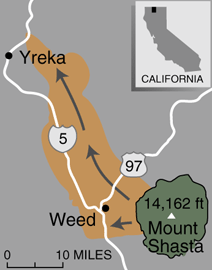
In this post I will examine what aspects make a good or a bad map. I have a few examples and will start off by looking at the bad map....
For some reason I cannot insert the picture itself but the map is poorly constructed. It has no title so right away there is no clue as to what it is trying to show. It is obviously of the Mount Shasta area, but has a strange color scheme going on, but no legend to tell the reader what it is showing. It shows two major roads, but again, unless you are familiar with the area you would have no idea. The map has two towns labeled, but no point to represent where they are so it is vague. The balance, placement and color of everything seems alright, but with no legend, it all has no meaning. The "bad map" also has some random arrows, again that have no meaning. There is no north arrow, and there is a scale. The problem with the scale though is that it has no numbers on it so therefore it is useless. This map did not have to be so poorly done. If the missing or poorly done aspects were corrected this might be an OK map. The bottom line is that now, in this context it is meaningless. It resembles little more than a map one might draw on a napkin in a restaurant. (http://pubs.usgs.gov/fs/fs002-97/images/Shastamap.gif)
The next map I would like to offer in comparison is a good, or better map showing recent earthquakes in California and Nevada. This is clearly what this map is showing because it is clearly stated in the title along with the contributing institutions. There is a scale and a legend and the colors used are easy to view and distinguish from one and other. The only problem I can really pick at here is the fact that the map contains earthquakes from the last hour, day, and week and there are some places where you cannot totally distinguish a point. It may be beneficial for this data to have a map for each one of these data sets. The size of the symbol for each earthquake shows approximate magnitude which is also distinguished in the legend. Perhaps the best aspect of this map is the fact that if you connect to it via the Internet, it is interactive. Not highly interactive but it does allow the user to select a point and it will zoom in and give you any additional/available information about the quake. If nothing else it zooms in and shows nearby towns and roads so one can get a better sense of where these quakes are. It is not the best map or the most intricate but it conveys its information in a cohesive way and is updated daily so its information is always current. ( http://pasadena.wr.usgs.gov/recenteqs/)